
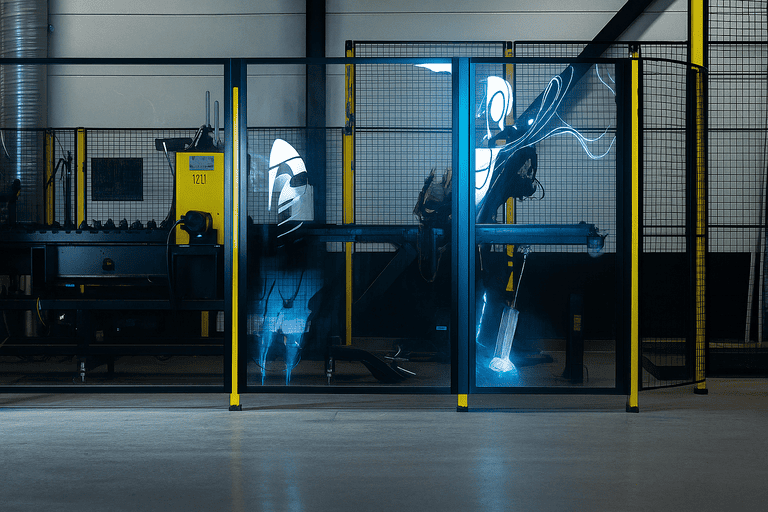
Executive Summary
Palladium Dynamics partnered with a Tier‑2 automotive components manufacturer in Pune to design, install, and commission an end‑to‑end robot safety fencing system. The project addressed frequent near‑misses and production stoppages caused by unsafe access to robotic cells. Within three months of commissioning, the solution improved safety compliance, reduced unauthorized access events, and increased effective production uptime.
Key outcome
- Enhanced worker safety and regulatory compliance
- Significant reduction in safety incidents and near‑miss events
- Improved production uptime and operational efficiency
- Clear ROI through reduced downtime and lower incident‑related costs
Client background
The client is a Pune‑based Tier‑2 supplier producing stamped and machined components for the automotive industry. Their factory uses multiple industrial robotic cells for welding, material handling, and assembly. Prior to the project, fencing solutions were inconsistent across cells and there was no standardized approach to access control, interlocks, or visibility for maintenance staff.
Challenges included:
- Inconsistent guarding across robotic cells
- Frequent unscheduled stoppages due to unauthorized access or false trips
- Limited access control and poor ergonomics for maintenance operations
- Need to meet international safety standards for automation suppliers
"The updated standards emphasize a proactive approach to machine guarding, requiring employers to conduct regular risk assessments and implement appropriate protective measures before machinery is put into operation."
Objectives
- Design a standardized, modular robot safety fencing system that fits diverse cell footprints.
- Implement reliable access control and interlock integration with PLCs and robot controllers.
- Improve visibility and ergonomics for operators and maintenance staff.
- Ensure compliance with relevant safety standards and support the client’s supplier audits.
- Minimize production downtime during installation and commissioning.
Solution overview
Palladium Dynamics delivered a turnkey solution that included:
- Modular steel-framed safety fencing with powder-coated panels for corrosion resistance and long-term durability.
- Mesh and polycarbonate panels in strategic locations to balance visibility and impact protection.
- Safety-rated interlock doors and key switches integrated with the robot controllers and plant PLC using safe I/O and configurable safety relays.
- Emergency stop (E‑Stop) pull cords and floor-level light curtain systems for high‑risk access points.
- Visual signalling (stack lights) and HMI updates to provide operators with clear cell states.
- A documented safety validation pack: risk assessment, Safety Functional Requirements (SFRs), validation tests, and user training.
Design highlights
- Modularity: Fencing modules (600mm, 900mm and 1200mm widths) allowed quick adaptation to different cell sizes and line reconfigurations.
- Safe integration: Safety interlocks wired to safety PLC channels and monitored via dual‑channel architecture to meet SIL 2 / PL d equivalent behaviours where required.
- Ergonomics: Sliding maintenance doors with monitored hold‑to‑run for inside-the-cell tasks and quick‑release hinges for emergency access.
- Visibility: Polycarbonate viewing panels at operator eye‑level and full-length mesh where inspection was frequent.
Implementation phases
- Site survey & risk assessment (1 week): Mapped existing cell layouts, performed task‑based hazard analysis, and prioritised cells.
- Design & approval (2 weeks): Developed CAD layouts and safety architecture; obtained stakeholder sign‑off.
- Fabrication & preassembly (3 weeks): Manufactured modular panels and prewired interlock assemblies in our Pune workshop.
- Installation (1 week per line): Installed fencing during planned maintenance windows to minimise production impact.
- Integration & commissioning (2 weeks): Integrated safety inputs with robot controllers and PLCs, performed Functional Safety Tests and FAT/SAT as required.
- Training & handover (3 days): Delivered operator and maintenance training plus handover documentation (SOPs, test records, inspection checklists).
Results (project outcomes)
Within 90 days post‑commissioning:
- Reduced safety incidents and near‑misses by approximately 85% (measured by reported unauthorized access events and near‑miss logs).
- Increased production uptime by 12% due to fewer unscheduled stoppages and faster safe restart procedures.
- Maintenance time per scheduled inspection reduced by 20% through improved access and ergonomic doors.
- Regulatory readiness: Client passed a supplier safety audit with no major non‑conformities related to robot guarding.
- ROI: Payback on the fencing investment estimated within 6–10 months driven by reduced downtime and incident‑related costs.
"Note: Results above reflect outcomes for this installation; actual figures will vary by factory and processes."
Technical & compliance details
- Standards referenced: Solution aligned with international robot and machine safety standards such as ISO 10218 and ISO/TS 15066 where collaborative elements existed.
- Safety architecture: Dual‑channel safety relays and monitored interlocks; emergency stop circuits routed through safety PLC inputs and logged for traceability.
- Materials: Mild steel frames, welded mesh, polycarbonate viewing panels (6–10mm), stainless fasteners in corrosive environments.
- Testing: Functional safety tests, lockout/tagout procedures documented, and verification records supplied at handover.
Client testimonial
“Palladium Dynamics delivered a practical, standards‑based fencing solution that improved our floor safety and reduced downtime. Their team worked around our production schedule and provided clear documentation for audits.” — Plant Manager, Automotive Components Manufacturer (Pune)
Why Palladium Dynamics?
- Local presence in Pune for fast response and ongoing support.
- End‑to‑end capability: design, fabrication, controls integration, and operator training.
- Focus on manufacturable, modular systems that scale with production changes.
- Emphasis on documentation and compliance to support supplier audits.
Call to action
Interested in a safety audit or a modular fencing quote? Contact Palladium Dynamics (Pune) for a free site survey and risk assessment.
Contact:
- Website: www.palladiumdynamics.com
- Phone: +91 95617 48741
- Email: info@palladiumdynamics.com