
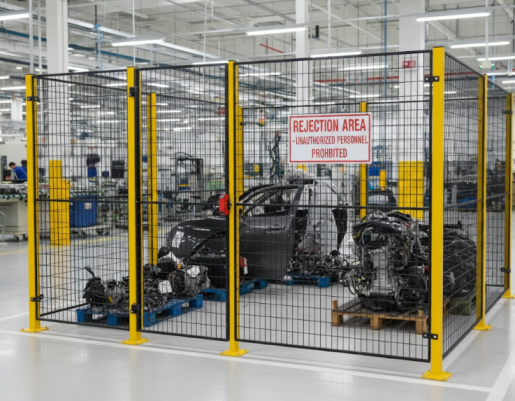
In Pune's thriving manufacturing landscape, proper segregation of non-conforming products is critical for quality assurance, regulatory compliance, and operational excellence. As a premier rejection area fence manufacturer serving automotive, pharmaceutical, electronics, and precision engineering industries across Maharashtra, we understand the vital role these specialized barriers play in maintaining production standards and preventing costly quality escapes.
Quick Answer
Palladium Dynamics is Pune's leading rejection area fence manufacturer, specializing in ISO-compliant quality control barriers for manufacturing facilities in Chakan, Ranjangaon, Talawade, and Pimpri-Chinchwad. We provide customized segregation fencing with color-coded identification, secure access controls, and full compliance with IATF 16949, ISO 9001, and industry-specific quality standards. Installation typically completes within 2-5 working days with prices ranging from ₹450 to ₹1,200 per running foot based on specifications.
Understanding Rejection Area Fencing: The Foundation of Quality Control
Rejection area fencing represents specialized physical barriers designed to isolate non-conforming products, defective materials, and items awaiting disposition decisions from conforming inventory within manufacturing facilities. Unlike standard warehouse partitions, rejection area fences serve as critical quality control infrastructure that prevents accidental use of rejected materials, ensures clear visual identification of segregated items, facilitates proper material flow management, and supports compliance with quality management system requirements.
For Pune's manufacturing sector, particularly in automotive hubs like Chakan and Ranjangaon where quality standards are paramount, rejection area fencing provides essential physical controls that complement procedural safeguards. These barriers create designated zones where suspect or non-conforming materials undergo evaluation, rework, or disposal processes without risk of re-entering production flows.
Why Pune Manufacturers Invest in Professional Rejection Area Fencing
Manufacturing facilities across Pune face increasing pressure from customers, regulatory bodies, and certification agencies to demonstrate robust quality control systems. Rejection area fencing addresses multiple critical needs simultaneously, making it an indispensable element of modern quality management infrastructure.
Quality escape prevention stands as the primary driver for rejection area fence implementation. By physically segregating non-conforming materials, manufacturers eliminate the risk of defective components accidentally entering assembly lines or shipping areas. This is particularly crucial in Pune's automotive supply chain where a single quality escape can trigger costly recalls, production stoppages at customer facilities, and severe financial penalties.
Regulatory compliance requirements mandate proper identification and segregation of non-conforming products across multiple quality standards. IATF 16949 automotive quality management systems specifically require controlled areas for rejected materials. ISO 9001 demands effective processes for preventing unintended use of non-conforming products. Pharmaceutical manufacturers must comply with FDA and WHO GMP requirements for material segregation, while electronics facilities follow IPC and customer-specific quality protocols.
Visual management enhancement through color-coded rejection area fencing supports lean manufacturing and 5S initiatives prevalent across Pune's progressive manufacturing facilities. Red-colored rejection zones create immediate visual alerts, support quick identification during audits, reinforce quality culture throughout the organization, and facilitate training of new personnel on proper material handling.
Industries Driving Demand for Rejection Area Fencing in Pune
Pune's diverse industrial ecosystem creates varied applications for specialized rejection area fencing, each with unique requirements and compliance considerations.
Automotive manufacturing and tier supplier facilities concentrated in Chakan, Ranjangaon, and Pimpri-Chinchwad represent the largest market segment for rejection area fencing in Pune. These facilities require segregation areas for rejected stampings and welded assemblies, non-conforming machined components, failed electronic modules and sensors, defective trim and interior components, and materials pending customer disposition decisions.
Automotive suppliers face stringent IATF 16949 requirements for rejection area management, often supplemented by customer-specific quality requirements from major OEMs. Rejection area fencing in these facilities typically features red powder coating for immediate identification, secure lockable access gates, integrated signage identifying material status, and floor markings coordinating with overhead barriers.
Pharmaceutical and medical device manufacturers in areas like Hinjewadi and Bhosari require rejection area fencing that meets cGMP standards for material segregation. These facilities manage rejected active pharmaceutical ingredients, non-conforming finished products, packaging materials failing quality checks, and materials pending quality assurance decisions. Pharmaceutical rejection areas often incorporate stainless steel construction for easy cleaning and sanitization, smooth surfaces without particle traps, documentation holders for batch records, and environmental monitoring provisions.
Electronics assembly and manufacturing facilities producing components for automotive, aerospace, consumer electronics, and industrial applications require ESD-safe rejection area fencing. These specialized barriers protect electronic components from electrostatic discharge, include grounding provisions and conductive materials, feature antistatic powder coating options, and integrate with facility-wide ESD control programs.
Palladium Dynamics: Leading Rejection Area Fence Manufacturer in Pune
As Pune's premier rejection area fence manufacturer, Palladium Dynamics brings specialized expertise in quality control infrastructure to manufacturing facilities across Maharashtra. Our comprehensive understanding of industry-specific requirements, compliance standards, and operational realities enables us to deliver solutions that enhance quality systems while supporting efficient production operations.
Our Specialized Approach to Rejection Area Fencing
Unlike generic fencing suppliers, we focus exclusively on industrial safety and quality control applications, developing deep expertise in the unique requirements of rejection area management. Our approach begins with thorough consultation to understand your specific quality management system, material flow patterns, compliance requirements, space constraints, and integration needs with existing infrastructure.
We design rejection area fencing systems that integrate seamlessly with your facility layout and quality processes, considering material flow from inspection to disposition, access patterns for quality personnel, visibility requirements for visual management, and future expansion needs as production grows. Our engineering team utilizes facility assessments and CAD drawings to optimize barrier placement, maximizing segregation effectiveness while minimizing impact on production floor space.
Quality Standards Compliance in Our Manufacturing
Every rejection area fence system we manufacture meets or exceeds relevant quality and safety standards applicable to Pune's manufacturing industries. Our ISO 9001:2015 certified manufacturing processes ensure consistent quality, documented traceability, regular calibration of measurement equipment, and continuous improvement practices.
Material specifications reflect industry best practices with structural components using minimum 40x40mm square tubing for posts and 25x25mm for intermediate members. We utilize powder coating systems providing 60-80 microns thickness for durability and corrosion resistance, with standard red color for rejection areas meeting visual management requirements. Mesh infill panels, when specified, use welded wire mesh with appropriate gauge for visibility and security balance.
Customization Capabilities for Pune Industries
Understanding that every manufacturing facility has unique requirements, we offer extensive customization options for rejection area fencing systems. Height variations accommodate different material types and stack heights, from 1200mm for small component storage to 2400mm for tall assemblies or increased security. Width and configuration options span from simple straight runs to complex L-shaped or U-shaped enclosures maximizing space utilization in constrained areas.
Access control integration enhances security and tracking with options including key-lockable gates for basic security, padlock provisions with documented access logs, electronic access control compatibility for advanced tracking, and card reader integration with existing security systems. Signage and identification provisions include integrated sign holders for material status documentation, custom warning labels in multiple languages, QR code mounting for digital tracking integration, and LED indicator provisions for visual status alerts.
Installation Excellence Across Pune's Industrial Zones
Our experienced installation teams serve manufacturing facilities throughout Pune Metropolitan Region, with particular expertise in Chakan automotive corridor, Ranjangaon industrial zone, Talawade manufacturing cluster, Pimpri-Chinchwad MIDC areas, Hinjewadi pharmaceutical facilities, and Bhosari electronics manufacturers.
We understand the operational challenges of installing safety infrastructure in active manufacturing environments, coordinating work during production downtime, minimizing disruption to ongoing operations, maintaining clean work areas preventing contamination, and completing projects on aggressive timelines. Our typical installation process spans 2-5 working days depending on system size, with options for expedited service when production schedules demand rapid implementation.
Comprehensive Pricing Guide: Rejection Area Fencing in Pune
Understanding cost structures for rejection area fencing helps manufacturing facilities budget accurately and compare vendor proposals effectively. Pricing varies based on specifications, materials, features, and installation complexity.
Standard Rejection Area Fencing: Entry-Level Solutions
Basic rejection area fencing suitable for general manufacturing applications typically costs ₹450 to ₹650 per running foot in Pune's market. These systems include 1500mm height steel tube framework, red powder coating finish, mesh or bar infill panels, simple swing gate access, and floor mounting with expansion anchors. A typical 10-foot x 10-foot rejection area enclosure with one access gate costs approximately ₹18,000 to ₹26,000 including basic installation.
Standard solutions work well for facilities with moderate compliance requirements, general manufacturing environments, non-critical component storage, and controlled access facilities. Many Pune manufacturers begin with standard rejection area fencing and upgrade to enhanced systems as quality programs mature.
Enhanced Rejection Area Systems: Mid-Range Solutions
Enhanced rejection area fencing incorporating additional security and compliance features typically ranges from ₹650 to ₹900 per running foot. These systems include heavier gauge structural components for increased durability, integrated signage holders and documentation provisions, lockable access gates with documented key control, enhanced powder coating for harsh environments, and coordinated floor marking and overhead signage.
A typical enhanced system for a 15-foot x 15-foot rejection area costs approximately ₹60,000 to ₹80,000 including installation and accessories. Enhanced solutions suit automotive tier suppliers requiring IATF 16949 compliance, facilities with significant audit activity, environments with valuable rejected materials, and operations requiring detailed access documentation.
Premium Rejection Area Solutions: Advanced Integration
Premium rejection area fencing systems with advanced features and integration capabilities range from ₹900 to ₹1,200 per running foot or more for specialized applications. These systems incorporate stainless steel construction for pharmaceutical or food applications, electronic access control with tracking and logging, integrated environmental monitoring provisions, specialized ESD-safe materials for electronics facilities, and custom configurations for unique operational requirements.
Large pharmaceutical rejection areas with stainless steel construction and environmental monitoring can exceed ₹2,00,000 for comprehensive installations. Premium solutions address stringent regulatory requirements, high-value material protection needs, facilities requiring detailed audit trails, and operations with complex disposition processes.
Cost Factors Affecting Rejection Area Fencing Pricing
Multiple variables influence final pricing for rejection area fencing projects in Pune manufacturing facilities. Understanding these factors enables accurate budgeting and meaningful vendor comparisons.
Material specifications significantly impact costs, with standard mild steel tube construction being most economical, stainless steel increasing costs by 40-60% for pharmaceutical applications, specialized ESD-safe materials adding 25-35% for electronics environments, and heavy-duty components for high-security applications adding 20-30%. Finish quality and durability affect long-term value, with standard powder coating providing 5-7 year lifespan in controlled environments, enhanced industrial powder coating extending life to 10-12 years, and specialized coatings for harsh environments providing 15+ year durability.
System complexity and customization drive significant cost variation. Simple rectangular enclosures with standard gates represent baseline pricing, while L-shaped or irregular configurations increase costs 15-25%, multiple access points add ₹8,000-₹15,000 per gate, and integrated documentation systems add ₹5,000-₹12,000 depending on sophistication. Installation considerations affecting pricing include ground floor installations representing standard pricing, mezzanine or elevated installations increasing costs 25-40%, installations around existing equipment adding 15-30% for complexity, and requirement for after-hours installation potentially adding 20-35% premium.
| System Type | Price Range (Pune) | Best For | Installation Time |
|---|---|---|---|
| Standard Rejection Fence | ₹450 - ₹650/ft | General manufacturing, basic compliance | 2-3 days |
| Enhanced System | ₹650 - ₹900/ft | Automotive tier suppliers, IATF 16949 | 3-4 days |
| Premium Solution | ₹900 - ₹1,200+/ft | Pharma, electronics, high-security needs | 4-5 days |
Compliance Requirements: Meeting Quality Management Standards
Rejection area fencing must satisfy multiple compliance requirements across different quality management systems and industry standards. Understanding these requirements ensures your investment supports certification objectives and withstands audit scrutiny.
IATF 16949 Automotive Quality Management Requirements
Automotive manufacturers and tier suppliers in Pune's extensive automotive ecosystem must comply with IATF 16949 requirements for non-conforming product control. These standards mandate clearly identified segregation areas for non-conforming products, physical or administrative controls preventing unintended use, documented processes for material disposition decisions, and traceability of rejected materials through final disposition.
Rejection area fencing provides the physical control element of IATF 16949 compliance, working in concert with procedural controls. Auditors typically verify that rejection areas are clearly marked and separated from conforming materials, secure from unauthorized access, properly documented with material status information, and integrated with corrective action processes. Our rejection area fencing systems are specifically designed to address these automotive quality requirements based on extensive experience with Pune automotive manufacturers.
ISO 9001 Quality Management System Requirements
ISO 9001:2015 clause 8.7 requires organizations to control non-conforming products to prevent unintended use or delivery. This includes identification of non-conforming outputs, segregation when practical, and documented disposition decisions. While ISO 9001 doesn't mandate specific physical barriers, rejection area fencing represents best practice implementation of these requirements, particularly in high-volume manufacturing environments where procedural controls alone may be insufficient.
During ISO 9001 audits, assessors evaluate the effectiveness of non-conforming product controls, often noting positively when physical segregation supplements procedural controls. Rejection area fencing demonstrates management commitment to quality control, provides visual evidence of effective systems, and facilitates training and awareness of quality requirements.
Pharmaceutical and Medical Device Compliance
Pharmaceutical manufacturers and medical device producers face stringent regulatory requirements from multiple authorities including FDA 21 CFR Part 211 for pharmaceuticals, ISO 13485 for medical devices, EU GMP guidelines for pharmaceutical production, and WHO GMP standards for international markets.
These regulations typically require physically separate or clearly demarcated areas for rejected materials, secure storage preventing cross-contamination, materials of construction suitable for cleaning and sanitization, and documented access control and material movement. Pharmaceutical-grade rejection area fencing features stainless steel construction for cleanability, smooth surfaces without particle traps, documentation provisions for batch records, and integration with environmental monitoring systems. Our pharmaceutical industry experience enables us to design systems meeting these specialized requirements.
Customer-Specific Quality Requirements
Many Pune manufacturers must satisfy customer-specific quality requirements beyond general industry standards. Major automotive OEMs often mandate specific color coding for rejection areas, particular dimensional requirements for segregation zones, integration with electronic tracking systems, and documented audit trails for material movements.
We work closely with customers to understand and implement these specific requirements, ensuring rejection area fencing systems support contractual quality obligations. Our experience across multiple industry sectors provides insight into common customer requirements and best practice implementations.
Design Considerations: Optimizing Rejection Area Fencing for Your Facility
Effective rejection area fencing requires careful design consideration beyond simple barrier installation. Optimal systems integrate with facility layout, material flow patterns, and quality management processes to enhance rather than impede operations.
Location and Layout Planning
Strategic placement of rejection areas within manufacturing facilities significantly impacts operational efficiency and compliance effectiveness. Proximity to inspection stations minimizes material handling distance and time, reducing cost and risk of mix-ups. Visibility from supervisor locations enables oversight without requiring dedicated monitoring, while accessibility for quality personnel facilitates efficient disposition processing. Separation from conforming material storage prevents accidental mixing, and consideration of material flow patterns minimizes cross-traffic and congestion.
We conduct detailed facility assessments identifying optimal rejection area locations considering these multiple factors. Our experience across Pune manufacturing facilities provides valuable perspective on layout strategies that work well in practice versus theoretical ideals that prove problematic in operation.
Size and Capacity Determination
Properly sizing rejection areas ensures adequate capacity without wasting valuable floor space. Undersized rejection areas quickly overflow causing compliance violations and operational problems, while oversized areas waste expensive manufacturing floor space. Factors to consider include typical rejection rates and volumes, material size and stacking characteristics, peak rejection periods and batch processing, and disposition cycle time from identification to final resolution.
Many Pune manufacturers benefit from multiple smaller rejection areas distributed strategically rather than one large central location. This approach minimizes material movement distances, provides dedicated capacity for different product lines, and simplifies visual management and material tracking.
Access Control and Security Features
Balancing security with operational efficiency requires thoughtful access control design. Basic lockable gates suit many applications, providing simple key control with documented access logs, quick access for authorized personnel, and audit-friendly simplicity. However, facilities with high-value rejected materials, sophisticated tracking requirements, or stringent audit demands may benefit from electronic access control systems.
Electronic access control options include card reader systems integrated with facility security, biometric access for enhanced security, automated logging of entries and exits, and integration with quality management software tracking material movements. We help customers evaluate access control needs based on material value, compliance requirements, audit frequency, and operational workflows.
Visual Management Integration
Rejection area fencing serves important visual management functions beyond physical segregation. Red color coding provides immediate visual identification aligning with standard safety and quality color conventions. Integrated signage communicates material status, handling requirements, and responsible personnel. Floor markings coordinate with overhead barriers defining segregation zones, while documentation provisions enable attachment of material tracking sheets, disposition instructions, and audit logs.
Our standard rejection area fencing designs incorporate visual management features learned from lean manufacturing and 5S implementations across Pune facilities. These elements enhance quality culture while supporting efficient audits and inspections.
Installation Process: What to Expect When Implementing Rejection Area Fencing
Professional installation ensures rejection area fencing performs as designed while minimizing disruption to manufacturing operations. Our systematic approach coordinates planning, fabrication, installation, and validation for seamless project execution.
Phase 1: Consultation and Design (1-2 Days)
Projects begin with comprehensive consultation where our technical team visits your Pune facility to understand quality management requirements and compliance standards, assess current rejection area practices and pain points, evaluate facility layout and material flow patterns, identify integration needs with existing systems, and review timing requirements and production schedules.
Following site assessment, we develop detailed proposals including CAD layout drawings showing optimal barrier placement, specifications for structural components and finishes, integrated features like signage and access control, compliance documentation addressing relevant standards, and detailed pricing with itemized components. This thorough planning phase ensures projects proceed smoothly with all stakeholders aligned on objectives and expectations.
Phase 2: Manufacturing and Fabrication (3-7 Days)
Once designs are approved, manufacturing begins in our Pune-area fabrication facilities. Structural components are precisely cut and formed to specifications, welding and assembly follows documented procedures, powder coating is applied in industrial coating systems with proper cure cycles, and quality control verifies dimensional accuracy and finish quality. For standard configurations, we often maintain inventory of common components enabling faster project completion. Custom configurations require full fabrication cycles but benefit from our efficient production processes.
Phase 3: Site Preparation and Installation (2-5 Days)
Installation timing is coordinated with your production schedule to minimize operational disruption. Many Pune manufacturers prefer installation during scheduled shutdowns, off-shifts, or weekends to avoid impacting production. Our experienced installation crews work efficiently completing most projects within 2-5 working days depending on system size and complexity.
Installation process includes floor marking and layout verification ensuring accuracy, anchor point drilling and installation for secure mounting, structural assembly and alignment following engineered drawings, gate and hardware installation with proper adjustment, signage and documentation holder attachment, and final inspection and touch-up addressing any finish issues. We maintain clean work areas throughout installation preventing contamination or debris issues in manufacturing environments.
Phase 4: Validation and Documentation (1 Day)
Project completion includes thorough validation ensuring systems meet specifications and compliance requirements. We document final dimensions and configurations, verify lockable gates function properly, confirm signage and visual management elements, provide operation and maintenance instructions, and deliver compliance documentation for quality system files.
For customers requiring formal validation protocols common in pharmaceutical and medical device manufacturing, we provide comprehensive IQ/OQ documentation supporting regulatory compliance and audit requirements.
Applications Across Pune's Manufacturing Industries
Rejection area fencing serves diverse applications across Pune's industrial landscape, each with unique operational and compliance characteristics. Understanding these varied applications helps manufacturers identify best practices applicable to their specific situations.
Automotive Component Manufacturing
Pune's extensive automotive manufacturing ecosystem spanning Chakan, Ranjangaon, and MIDC areas creates substantial demand for specialized rejection area fencing. Automotive applications include segregation of stamped components failing dimensional checks, castings with porosity or dimensional defects, machined parts outside tolerance specifications, failed electronic components and sensors, and assemblies with functional defects.
Automotive rejection areas typically feature IATF 16949-compliant design and documentation, integration with 8D corrective action processes, sorting areas for containment activities, and capacity for material holds pending customer decisions. Material disposition cycles in automotive facilities can span days to weeks as root cause analysis proceeds and customer approvals are obtained, requiring adequate rejection area capacity.
Pharmaceutical Manufacturing and Packaging
Pharmaceutical manufacturers in Hinjewadi and other Pune pharmaceutical hubs implement rejection area fencing meeting stringent cGMP requirements. Pharmaceutical applications include API batches failing purity specifications, tablets or capsules with cosmetic or content defects, packaging materials failing quality checks, and finished products awaiting quality assurance disposition.
Pharmaceutical rejection area fencing prioritizes cleanability and compliance with stainless steel construction enabling sanitization, smooth surfaces preventing particle generation, environmental monitoring provisions for temperature and humidity, and integration with batch documentation systems. Cross-contamination prevention is critical, often requiring separate rejection areas for different product families.
Electronics Assembly and Manufacturing
Electronics manufacturers producing automotive electronics, consumer devices, and industrial controls require ESD-safe rejection area fencing protecting sensitive components. Electronics applications include PCB assemblies failing electrical test, components with cosmetic defects, products with intermittent failures requiring investigation, and materials pending failure analysis.
ESD-safe rejection area fencing incorporates conductive materials and grounding provisions, antistatic powder coating finishes, integration with facility ESD control programs, and appropriate signage for ESD-sensitive items. Electronics rejection areas often include workstations for rework or analysis within the controlled environment.
Precision Engineering and Machining
Job shops and contract manufacturers across Pune's industrial areas serve diverse customers requiring rigorous quality control. Precision manufacturing applications include machined components failing dimensional verification, parts with surface finish defects, assemblies with functional issues, and materials pending customer inspection or approval.
These facilities often require flexible rejection area configurations accommodating varied component sizes and shapes, clear job identification and tracking systems, and capacity for extended holds pending customer feedback. Rejection area fencing in precision manufacturing facilities emphasizes flexibility and clear identification supporting diverse product mixes.
Maintenance and Long-Term Performance
Proper maintenance ensures rejection area fencing continues performing effectively throughout its expected 10-15 year lifespan. While these systems require minimal maintenance compared to machinery or equipment, regular attention preserves appearance, functionality, and compliance effectiveness.
Routine Maintenance Schedule
Establishing regular maintenance routines prevents issues and extends system life. Weekly visual inspections identify any damage or wear requiring attention. Monthly detailed inspections should verify structural integrity checking for loose bolts or damaged welds, gate function ensuring smooth operation and proper latching, finish condition noting any coating damage or corrosion, and signage legibility confirming labels remain clear and attached.
Quarterly lubrication of gate hinges and latches maintains smooth operation, while annual comprehensive assessments evaluate overall system condition, identify any structural repairs needed, assess finish condition and touch-up requirements, and review capacity adequacy as operations evolve. We provide detailed maintenance checklists supporting customer maintenance programs.
Common Issues and Solutions
Understanding typical issues enables quick resolution minimizing operational impact. Gate alignment problems often develop over time from repeated use, causing difficult operation or improper latching. Simple adjustment of hinges or strike plates typically resolves these issues. Finish damage from impacts or harsh environments can be addressed through touch-up painting, though significant damage may require re-coating sections. Structural damage from forklift impacts or overloading is uncommon but requires professional repair to maintain system integrity.
We provide ongoing support for our Pune customers including maintenance guidance and specifications, touch-up paint matching original finishes, structural repair services when needed, and modification services as operations evolve. Our goal is ensuring rejection area fencing continues supporting quality objectives throughout its full lifespan.
Pune Climate Considerations
Pune's climate with distinct summer, monsoon, and winter seasons requires consideration in rejection area fencing specification and maintenance. High-quality powder coating resists typical Pune weather conditions, but facilities with significant outdoor exposure or harsh internal environments may benefit from enhanced coating systems.
Monsoon season humidity can affect facilities with poor environmental control. Regular inspection during and after monsoons identifies any moisture-related issues early. Facilities with aggressive chemical environments or wash-down requirements should specify appropriate coating systems or stainless steel construction resistant to these conditions.
Return on Investment: The Business Case for Quality Rejection Area Fencing
Investment in professional rejection area fencing delivers measurable returns through reduced quality costs, improved compliance, and enhanced operational efficiency. Understanding these benefits helps justify expenditure and prioritize quality infrastructure investments.
Quality Cost Reduction
Rejection area fencing directly reduces quality costs by preventing expensive quality escapes. A single quality escape can cost orders of magnitude more than comprehensive rejection area infrastructure. Consider a typical scenario: Pune automotive tier-1 supplier invests ₹150,000 in rejection area fencing throughout a 50,000 square foot facility. This investment prevents a single quality escape that would have cost ₹500,000 in sorting charges at customer facility, ₹200,000 in premium freight and expediting, ₹300,000 in customer penalty charges, and ₹150,000 in internal containment and corrective action costs.
Total quality escape cost of ₹1,150,000 dwarfs the ₹150,000 rejection area investment, providing 7.7x return from preventing just one incident. Many manufacturers experience 2-4 quality escapes annually without proper controls, multiplying these returns substantially. Beyond dramatic escape scenarios, rejection area fencing reduces smaller daily costs including inspection time finding and verifying material status, material handling errors and rework, and inventory carrying costs from poor material management.
Compliance and Certification Benefits
Professional rejection area fencing supports quality system certification and customer approvals essential for business development. Automotive suppliers pursuing IATF 16949 certification or renewal find auditor approval easier with proper physical controls. Pharmaceutical manufacturers demonstrate cGMP compliance more convincingly with appropriate infrastructure. ISO 9001 audits proceed more smoothly with clear non-conforming product controls, and customer audits generate fewer findings with professional rejection area systems.
Certification benefits extend beyond initial approval to ongoing business relationships. Customers conducting periodic audits view professional rejection area infrastructure as evidence of quality system maturity and management commitment. This supports contract renewals, qualification for additional programs, and preferential consideration for new business opportunities.
Operational Efficiency Improvements
Well-designed rejection area fencing enhances operational efficiency through improved organization and material management. Clear segregation eliminates time wasted searching for materials, reduces errors from incorrect material usage, streamlines disposition processes, and supports lean manufacturing initiatives. Quality personnel spend less time managing non-conforming materials when proper infrastructure supports their processes.
Many Pune manufacturers report that rejection area implementation catalyzes broader quality system improvements. Visual management draws attention to rejection rates, prompting root cause investigations. Clear material tracking enables better analysis of quality trends. Physical infrastructure reinforces procedural improvements creating a positive quality culture feedback loop.
Frequently Asked Questions About Rejection Area Fencing in Pune
What defines a compliant rejection area fence for IATF 16949?
IATF 16949 doesn't specify exact physical requirements but mandates control of non-conforming products to prevent unintended use. Compliant rejection area fencing typically includes clear visual identification through red color coding, physical segregation preventing accidental mixing with conforming materials, secure access controls with documented authorization, integrated documentation provisions for material status and tracking, and sufficient capacity for anticipated rejection volumes. During IATF 16949 audits, assessors verify that controls effectively prevent quality escapes and that systems integrate with broader quality management processes.
Can rejection area fencing be used for other segregation needs?
While optimized for non-conforming product control, similar fencing systems serve other manufacturing segregation needs including quarantine areas for incoming material inspection, hold areas for materials pending test results or documentation, segregation of customer-owned materials or consignment inventory, and separation of different product families preventing cross-contamination. The same design principles and compliance benefits apply across these applications, though color coding may differ from standard red rejection area identification.
How much space should be allocated for rejection areas?
Rejection area sizing depends on multiple factors specific to each facility including typical rejection rates and volumes, material physical characteristics and stacking, disposition cycle time from identification to resolution, batch sizes and lot processing patterns, and seasonal variation in production and rejection volumes. General guidance suggests sizing for 2-4 weeks of typical rejection volume providing buffer against disposition delays. However, operations with fast disposition cycles may require less capacity, while those with extended customer approval processes need more. We help customers analyze these factors determining appropriate rejection area sizing.
What material options are available for different environments?
Rejection area fencing material selection depends on environmental and regulatory considerations. Standard carbon steel with powder coating suits most general manufacturing environments providing 10-15 year life with minimal maintenance. Stainless steel construction is required for pharmaceutical applications, recommended for food processing or wet environments, and preferred for harsh chemical exposures. ESD-safe materials with special conductive coatings are necessary for electronics manufacturing, while standard materials with added grounding provisions suit less sensitive applications. We help customers select appropriate materials based on operational requirements and budget considerations.
Can rejection area fencing be relocated if facility layouts change?
Quality rejection area fencing systems are typically designed for permanent installation with floor-anchored posts, though relocation is possible with professional assistance. Modular systems with bolted connections facilitate disassembly and reinstallation, though some components may require replacement. For facilities anticipating layout changes, we can design systems with relocation in mind, using heavier floor plates instead of embedded anchors or incorporating modular design facilitating reconfiguration. However, frequent relocation is impractical and may compromise structural integrity, so careful initial placement is important.
What documentation should rejection area fencing suppliers provide?
Professional rejection area fence manufacturers should provide comprehensive documentation supporting quality system requirements including detailed specifications for all materials and components, installation drawings showing as-built configuration, material certifications and test reports where applicable, powder coating specifications and test results, operation and maintenance instructions, and compliance statements addressing relevant standards. For pharmaceutical and medical device applications, formal IQ/OQ protocols may be necessary. We provide documentation packages tailored to customer quality system requirements and regulatory obligations.
How does Pune's climate affect rejection area fencing durability?
Pune's relatively mild climate with moderate temperatures and distinct monsoon season generally supports excellent rejection area fencing durability. Quality powder coating withstands typical Pune conditions for 10-15 years in climate-controlled facilities and 8-12 years in warehouses with environmental exposure. Monsoon humidity requires consideration in facilities without climate control, though proper powder coating provides adequate protection. Facilities with outdoor exposure, aggressive chemical environments, or regular wash-down operations should specify enhanced coating systems or stainless steel construction. Regular maintenance including inspection and touch-up prevents minor finish damage from developing into significant corrosion issues.
What lead times should be expected for rejection area fencing projects in Pune?
Project timelines vary with system complexity and customization requirements. Standard rejection area configurations using common components typically complete within 7-10 working days from order to installation, including consultation and design, fabrication and finishing, and installation and validation. Custom configurations requiring unique dimensions, specialized materials, or complex integration may require 3-4 weeks. We maintain inventory of common components enabling faster turnaround for standard systems. For urgent projects, expedited service can reduce timelines by 30-40% though this may affect pricing. We work closely with customers to understand timing requirements and structure projects accordingly.
Ready to Implement Compliant Rejection Area Fencing in Pune?
Contact Palladium Dynamics for expert consultation on rejection area fencing solutions tailored to your manufacturing facility. Serving automotive, pharmaceutical, electronics, and precision manufacturing industries across Pune, Chakan, Ranjangaon, and throughout Maharashtra with ISO-compliant quality control barriers.
Conclusion: Building Quality Excellence Through Proper Infrastructure
Rejection area fencing represents critical quality control infrastructure for manufacturing facilities across Pune's diverse industrial landscape. From automotive tier suppliers in Chakan to pharmaceutical manufacturers in Hinjewadi and electronics facilities throughout MIDC areas, proper segregation of non-conforming materials supports compliance objectives while preventing costly quality escapes.
Selecting the right rejection area fence manufacturer ensures your investment delivers long-term value through compliant design meeting IATF 16949, ISO 9001, and industry-specific standards, quality construction providing 10-15 year service life, professional installation minimizing operational disruption, and comprehensive support from consultation through maintenance. As Pune's leading rejection area fence manufacturer, Palladium Dynamics brings specialized expertise in quality control infrastructure to manufacturing facilities across Maharashtra.
Our systematic approach addresses the full scope of rejection area requirements from initial consultation understanding your specific compliance needs and operational constraints, through custom design optimizing layout for efficiency and effectiveness, quality manufacturing using premium materials and proven fabrication processes, professional installation coordinating with production schedules, to ongoing support ensuring continued performance and compliance. We understand the critical role rejection area fencing plays in quality management systems and the significant consequences of quality escapes in competitive manufacturing markets.
Investment in professional rejection area fencing delivers measurable returns through reduced quality costs preventing expensive escapes and rework, improved compliance supporting certifications and customer requirements, enhanced efficiency through better organization and material management, and strengthened quality culture through visible commitment to quality systems. For many Pune manufacturers, rejection area infrastructure pays for itself by preventing a single quality escape while delivering ongoing benefits year after year.
As manufacturing quality standards continue evolving and customer expectations increase, proper physical controls become increasingly important. Procedural controls alone prove insufficient in high-volume production environments where human error risks quality escapes. Rejection area fencing provides the physical safety net ensuring non-conforming materials never reach customers regardless of procedural breakdowns or training gaps.
For manufacturing facilities across Pune considering rejection area fencing implementation or upgrading existing systems, the path forward involves comprehensive assessment of current practices and pain points, definition of specific compliance and operational requirements, consultation with experienced manufacturers understanding industry needs, evaluation of proposals considering total value rather than just price, and planning implementation to minimize operational disruption. We stand ready to guide Pune manufacturers through this process, bringing decades of combined experience in industrial safety and quality control infrastructure.
The future of manufacturing in Pune increasingly emphasizes quality, efficiency, and compliance. Facilities investing in proper infrastructure including professional rejection area fencing position themselves for continued success in competitive markets. Whether pursuing new certifications, responding to customer requirements, or simply strengthening quality systems, rejection area fencing represents foundational infrastructure supporting these objectives.
Partner with Palladium Dynamics for rejection area fencing solutions that enhance your quality management system, support compliance objectives, and deliver lasting value. Our commitment to quality, customer service, and technical excellence makes us Pune's preferred rejection area fence manufacturer serving manufacturing facilities throughout Maharashtra. Contact us today to discuss your rejection area requirements and discover how proper infrastructure can strengthen your quality systems while preventing costly quality escapes.